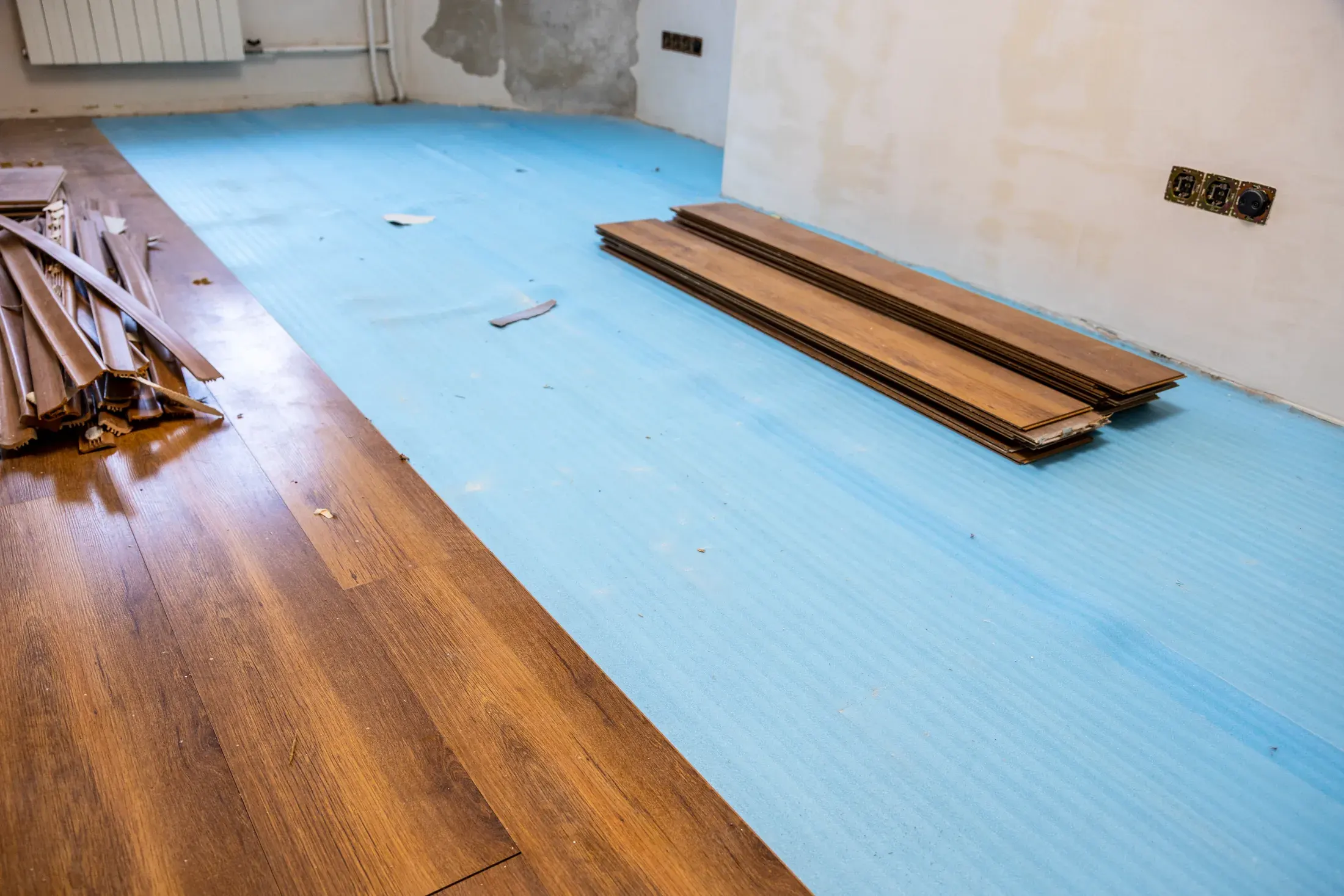
Laminate flooring cost in Amarillo
| Item | Cost | Typical | Source & scope |
|---|---|---|---|
| Laminate flooring, installed | $5.50–$6 / sq ft | About $2,800 for a 500 sq ft room; Texas statewide runs $2.75–$10 | Amarillo-specific sourceHomeyou Amarillo page (installed range); Texas statewide band from a 2026 Texas laminate cost catalog, September 2026 |
| 6-mil polyethylene vapor barrier under a floating floor (laminate, some LVP, engineered hardwood) | $0.20–$0.30 / sq ft | — | Texas statewide source — no Amarillo-specific figure found2026 Texas laminate installation cost catalog, April 2026 |
Two things to read off that table. First, the Amarillo figure is a blended installed average — plank, underlayment, and labor — and lands squarely inside the Texas statewide band rather than at either end of it. Second, the vapor barrier is listed separately on purpose: it is a Texas statewide figure, not an Amarillo one, and it is the line item most often missing from a low bid.
Why Texas laminate runs $2.75 to $10 — and where Amarillo sits
The statewide band is wide because "laminate" covers a lot of product and a lot of labor market. The same source that publishes it notes Texas runs roughly 15% below the national average for laminate, with rural Texas cheaper still. Here is what pushes a job toward each end:
| Factor | Toward the low end | Toward the high end |
|---|---|---|
| Plank grade | AC3, 7–8 mm, standard embossing | AC4–AC5, 12 mm, embossed-in-register texture, beveled edges |
| Underlayment | Attached pad, no separate barrier (wood subfloor) | Separate acoustic underlayment plus the 6-mil barrier a slab requires |
| Room shape | Open rectangles, few transitions | Many doorways, closets, stair nosings, diagonal layouts |
| Prep | Flat, dry, bare slab | Old flooring to remove, self-leveler on a wavy slab, a failed moisture test |
| Labor market | Rural Panhandle crews | Metro Texas rates |
Amarillo's $5.50–$6 / sq ft sits mid-band because its labor rates are Panhandle rates, but the slab under most local homes drags nearly every job into the "separate barrier" column.
AC ratings: the one spec that matters on the box
Laminate wear resistance is rated on the AC (abrasion class) scale, and it is a better guide to how the floor will hold up than thickness or price.
| Rating | Intended use | Where it makes sense in a house |
|---|---|---|
| AC1–AC2 | Light residential | Guest rooms, closets — rarely worth the small saving |
| AC3 | General residential | Living rooms, bedrooms, home offices — the default floor |
| AC4 | Heavy residential / light commercial | Kitchens, hallways, entries, homes with large dogs or rolling chairs |
| AC5 | Heavy commercial | Overkill for most homes; the money is better spent on a thicker core or better underlayment |
Amarillo adds one reason to lean toward AC4 in entries and hallways: the Panhandle's blowing dust. The National Weather Service describes winds of 50 mph or more every year, often with blowing dust, and fine grit tracked in on shoes is exactly what an abrasion rating is rated against.
The barrier is not optional: laminate over an Amarillo slab
The City of Amarillo's own Panhandle Residential Foundation Manual says the majority of Texas foundations are slab-on-ground, many on expansive clays. Laminate's core is high-density fiberboard — compressed wood fiber that swells and never fully recovers when it absorbs moisture. That combination is why every serious laminate source treats the over-slab vapor barrier as mandatory rather than recommended.
- Moisture test first. An in-situ relative-humidity probe (ASTM F2170) or calcium-chloride test (ASTM F1869), with the plank manufacturer's stated limit as the number that counts. Dry Amarillo air says nothing about the soil under a slab.
- 6-mil polyethylene sheet over the slab, seams overlapped and taped, run up the wall behind the baseboard — about $0.20–$0.30 / sq ft installed per the Texas source. This is separate from the under-slab retarder the building code calls for at the pour (IRC R506.2.3), which you cannot inspect and an older home may not have.
- Foam or combination underlayment on top of the sheet, unless the plank has an attached pad rated for use over concrete with a separate barrier.
- Expansion gap at every wall and fixed object — laminate floats, and Amarillo's swings between humid summer storms and sub-15% spring humidity make the gap earn its keep.
A quote that reads "laminate, installed" with no barrier line on a slab home is either absorbing it silently or skipping it. Ask which. The slab foundation & vapor barrier guide covers the test methods and the two-barrier distinction in full.
Where laminate still beats LVP
LVP has taken most of laminate's market because it is waterproof and cheaper in Amarillo ($2.50–$4 / sq ft installed). Laminate keeps three real advantages, and they matter in specific rooms:
| Laminate | LVP / vinyl plank | |
|---|---|---|
| Dent and scratch resistance | Harder surface — resists furniture legs, dog claws, dropped pans better | Softer; rigid-core (SPC) narrows the gap, flexible vinyl does not |
| Wood look | Deeper embossing, more convincing grain at the same price | Good, improving every year, still flatter at budget tiers |
| Water | Core swells — bad for baths, laundry, and slab leaks | Waterproof plank (the seams and subfloor are another matter) |
| Over an Amarillo slab | Needs the 6-mil sheet, every time | Needs a flat slab and a passing moisture test; a sheet only if the product says so |
| Installed cost, Amarillo | $5.50–$6 / sq ft | $2.50–$4 / sq ft |
| Feel underfoot | Firmer, hollower without good underlayment | Quieter, warmer, slightly softer |
Laminate in bedrooms and living rooms, LVP in kitchens and baths, is the split that survives most Amarillo houses. The laminate vs. LVP comparison goes room by room; against hardwood (~$8 / sq ft installed), see hardwood vs. laminate.
Vetting a laminate installer when Texas has no license
Texas does not license flooring contractors and the City of Amarillo does not issue contractor ID numbers. What you can check: a certificate of general liability insurance naming you as certificate holder, the company's Better Business Bureau standing, and — if the job repairs the slab or builds a subfloor — a call to the City of Amarillo — Building Safety Division at 806-378-3041. Then ask two laminate-specific questions: "Do you moisture-test slabs, and with which method?" and "Is the 6-mil barrier a line on this quote?" The full vetting guide has the step-by-step.
Methodology
Amarillo-specific per-square-foot ranges (hardwood installation and refinishing, LVP/vinyl, laminate, carpet, tile) are compiled from a September 2026 Amarillo-market pull; the refinishing figure comes from a dozen Amarillo quotes (AMA-004). Where no Amarillo-specific figure exists — the slab vapor barrier (a Texas statewide figure), the top of the tile range, and old-flooring removal (labeled national proxies) — the range is labeled by scope rather than filled with an invented local number. Ranges are materials + labor for a typical installation and do not include subfloor repair, furniture moving, or old-flooring removal/disposal unless stated. Rechecked quarterly.
Verified 2026-09-05. Texas does not require a state contractor license for flooring installation, refinishing, or repair — it is not a TDLR-regulated trade (TX-002). That puts more of the vetting burden on you: ask any company for proof of general liability insurance, check their standing with the Better Business Bureau, and — for work that touches the subfloor or slab — confirm whether the job needs a City of Amarillo permit before work starts. The City of Amarillo does not issue contractor ID numbers, so a company citing a "city license number" for flooring work is a vetting red flag, not a credential (AMA-001). Verify permit requirements yourself with the City of Amarillo Building Safety Division at 806-378-3041.