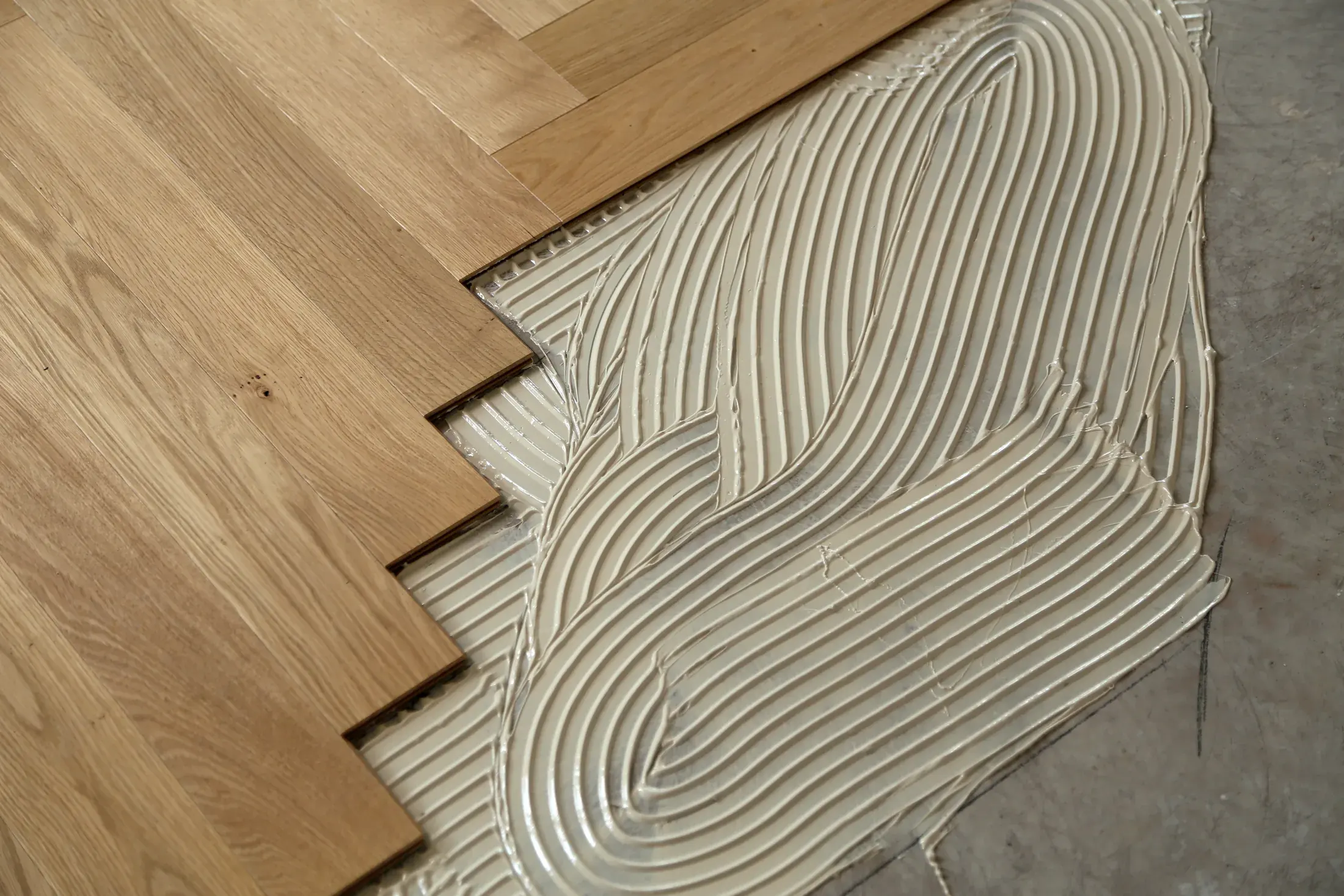
Hardwood installation cost in Amarillo
| Job | Cost | Typical | Source & scope |
|---|---|---|---|
| Hardwood flooring, installed | ~$8 / sq ft | About $8,000 for a 1,000 sq ft home, materials + labor | Amarillo-specific sourceHomeyou, Amarillo-specific hardwood installation page, September 2026 |
| Hardwood floor refinishing | ~$3 / sq ft | About $3,564–$3,887 for a 1,200 sq ft floor; $300–$1,500 per room | Amarillo-specific sourceHomeyou, Amarillo-specific refinishing page (12 Amarillo quotes), August 2026 |
The Amarillo install figure is a blended average across species and install methods — a glue-down engineered oak lands under it, a nail-down solid hickory over a new plywood subfloor lands over it. Both figures are Amarillo-specific, which is unusual: on most sibling sites the refinishing number has to be a national proxy. Here it comes from a dozen actual Amarillo refinishing quotes.
What moves a hardwood quote up or down
- Solid vs. engineered — engineered usually prices lower and is the safer pick over a slab
- Wood species — oak and hickory price below walnut or exotic species
- How it goes down over a slab: glue-down engineered vs. a plywood subfloor for nail-down solid
- Subfloor or slab prep — moisture testing, leveling, and a vapor barrier are separate line items
- Finish: prefinished planks cost more per box but skip on-site sanding and finishing; site-finished floors cost more in labor and days of downtime but end up seamless.
- Board width and pattern: wide planks and herringbone or chevron layouts raise material waste and labor time.
Solid vs. engineered — and why the slab decides
The City of Amarillo's own Panhandle Residential Foundation Manual notes that the majority of Texas foundations are shallow slab-on-ground, many on expansive clays. That single fact does more to decide this question than taste does.
| Solid hardwood | Engineered hardwood | |
|---|---|---|
| Over a slab | Needs a plywood subfloor system (sleepers or glued plywood) over a vapor retarder first — adds height, material, and labor | Glues down or floats directly over a tested, dry slab |
| Dry-air movement | Shrinks and gaps in low humidity; widest boards move most | Cross-laminated core moves less |
| Refinishing | Sandable many times over decades | Depends on wear-layer thickness: a thin veneer may take a recoat only, a thick one several sandings |
| Cost | Higher once the subfloor system is counted | Usually lower installed over a slab |
On a pier-and-beam house with a wood subfloor — some older Amarillo neighborhoods have them — solid hardwood nails straight down and the calculus flips. Ask which foundation you have before you ask for a hardwood quote; the answer changes the price by more than the species does.
Installing hardwood over an Amarillo slab: the three checks
- Moisture test the slab first. Industry guidance for wood over concrete is an in-situ relative humidity reading (ASTM F2170) that typically should not exceed 75%, or a calcium-chloride emission rate (ASTM F1869) below about 3 lbs per 1,000 sq ft per 24 hours — with the flooring and adhesive manufacturer's own limits as the final word. Amarillo's air is dry; the ground under a slab is not necessarily. A slab that fails the test needs a moisture-mitigation coating before wood goes down.
- Vapor retarder. The International Residential Code (R506.2.3) calls for a 6-mil polyethylene vapor retarder under the slab of a conditioned space, and Amarillo's foundation manual is built to comply with the 2015 IRC — but an older home, a damaged sheet, or a slab poured to an earlier code may not have one you can trust. Floating engineered floors get a 6-mil sheet on top of the slab, about $0.20–$0.30 / sq ft installed per a Texas statewide source; glue-down installs rely on the adhesive's moisture rating.
- Acclimation. Hardwood is delivered ahead of installation and left in the room at normal living conditions until it stabilizes — commonly cited guidance is 30–50% indoor relative humidity held for several days before delivery. In an Amarillo winter, running a humidifier for the first season is not fussy; it is how you avoid gaps you can see from the doorway.
The slab foundation & vapor barrier guide goes through each of these in full, for every material.
Refinishing: the cheaper lane, with a real Amarillo number
Refinishing in Amarillo runs about ~$3 / sq ft — $3,564–$3,887 for a 1,200 sq ft floor; $300–$1,500 per room — per a dozen local quotes pulled August 2026. That is a different, cheaper job than installing new, not a discount off it. What moves it:
- Screen-and-recoat (cheapest) vs. a full sand-and-refinish (most of the cost is labor)
- Number of finish coats and finish type (oil-based vs. water-based polyurethane)
- Floor condition — deep gouges, pet stains, or water damage add sanding time
- A stain color change adds a step over a natural-tone refinish
The one thing refinishing cannot fix is a floor that has already been sanded to the tongue, or an engineered floor with a wear layer too thin to sand. A competent refinisher will check board thickness at a register or threshold before quoting. The refinishing cost page covers screen-and-recoat vs. full sand in more detail.
Hardwood vs. LVP in Amarillo, briefly
LVP installs for $2.50–$4 / sq ft in Amarillo against hardwood's ~$8 / sq ft, goes straight over a slab, and shrugs off the dry air. Hardwood wins on resale, refinishability, and how it feels underfoot. On a slab-foundation home where the budget is tight, that is the honest trade — see the LVP vs. hardwood comparison for the full breakdown, including which rooms each material actually suits.
Vetting a hardwood installer when Texas has no license
Texas does not license flooring contractors and the City of Amarillo does not issue contractor ID numbers, so the checks that matter are different from what you might expect: a certificate of general liability insurance naming you as certificate holder, the company's Better Business Bureau standing, and — if the job builds a subfloor over the slab — a call to the City of Amarillo — Building Safety Division at 806-378-3041 about permits. Ask specifically whether they moisture-test slabs and how; an installer who says "we don't need to in Amarillo, it's dry" has answered a different question than the one you asked. The full vetting guide has the step-by-step.
Methodology
Amarillo-specific per-square-foot ranges (hardwood installation and refinishing, LVP/vinyl, laminate, carpet, tile) are compiled from a September 2026 Amarillo-market pull; the refinishing figure comes from a dozen Amarillo quotes (AMA-004). Where no Amarillo-specific figure exists — the slab vapor barrier (a Texas statewide figure), the top of the tile range, and old-flooring removal (labeled national proxies) — the range is labeled by scope rather than filled with an invented local number. Ranges are materials + labor for a typical installation and do not include subfloor repair, furniture moving, or old-flooring removal/disposal unless stated. Rechecked quarterly.
Verified 2026-09-05. Texas does not require a state contractor license for flooring installation, refinishing, or repair — it is not a TDLR-regulated trade (TX-002). That puts more of the vetting burden on you: ask any company for proof of general liability insurance, check their standing with the Better Business Bureau, and — for work that touches the subfloor or slab — confirm whether the job needs a City of Amarillo permit before work starts. The City of Amarillo does not issue contractor ID numbers, so a company citing a "city license number" for flooring work is a vetting red flag, not a credential (AMA-001). Verify permit requirements yourself with the City of Amarillo Building Safety Division at 806-378-3041.